
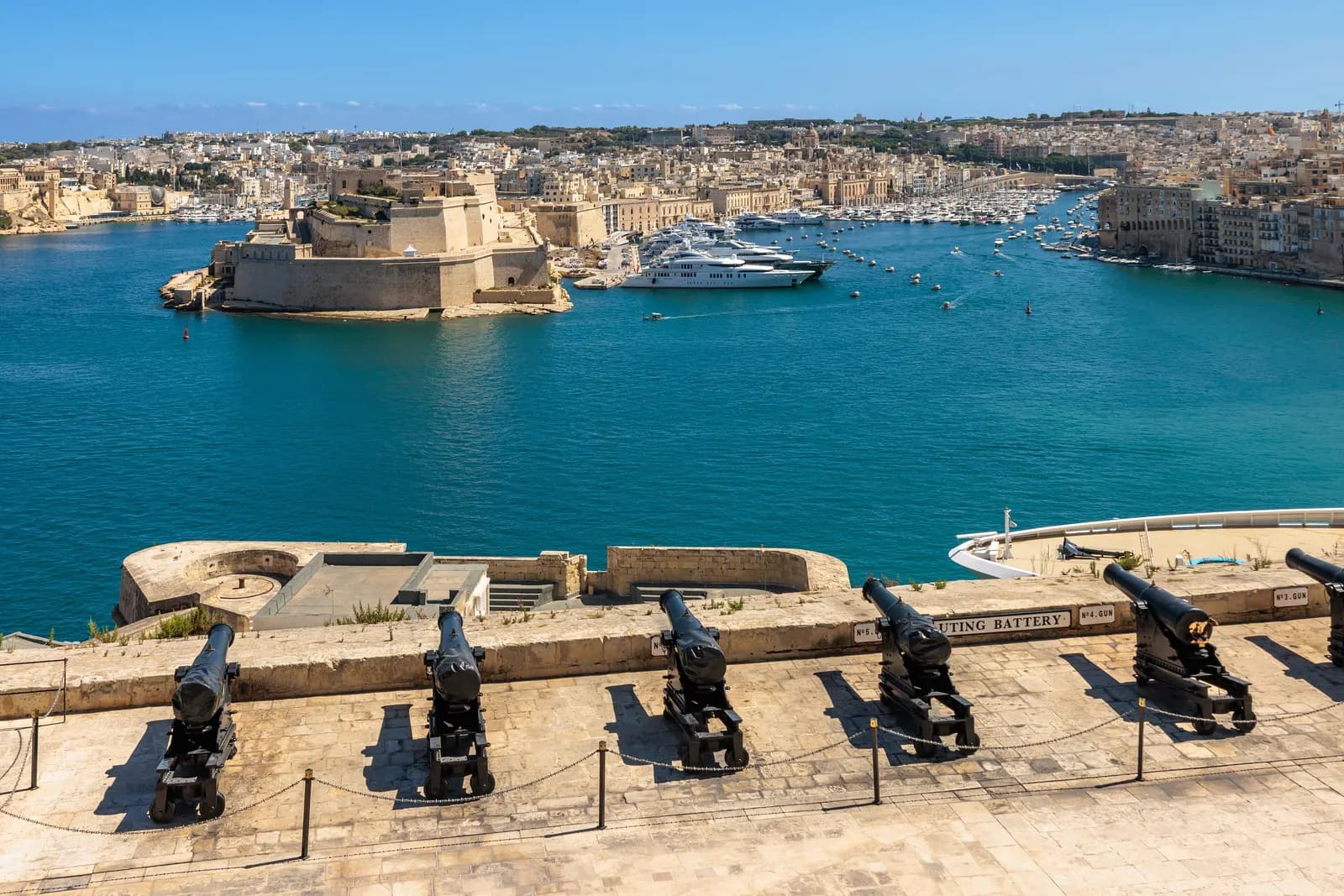
Study in Malta
Study in English in the heart of the Mediterranean, with options spanning academic degrees, applied education and specialist training. Malta brings together the University of Malta, MCAST, the Institute of Tourism Studies and private higher-education providers in a compact European Union destination. Whether you are considering business, computing, engineering, hospitality or medicine, the right choice depends on your academic background, budget and plans after graduation.
Malta may suit you if…
- You want to study primarily in English within the European Union.
- You prefer a smaller study destination to a large university city.
- You are interested in business, computing, engineering, tourism, hospitality, health sciences or other applied subjects.
- You want to compare research-focused university degrees with practical and technical study.
- You are considering a Bachelor's degree, Master's degree, doctorate or eligible higher-education diploma.
- You want to compare public and private institutions, including different routes into medical study.
Advantages and trade-offs
Advantages
- English-medium education: English is an official language of Malta and is widely used in higher education.
- Recognised qualifications framework: The Malta Further and Higher Education Authority (MFHEA) regulates the licensing and accreditation framework. You can check providers and programmes in the Malta Qualifications Database.
- Academic and practical pathways: The University of Malta offers broad academic and research-based study; MCAST has an applied and technical focus; and the Institute of Tourism Studies specialises in hospitality and tourism.
- Specialist options: Private institutions and Queen Mary University of London's Malta medical campus expand the range of subjects and teaching environments.
- A potential post-study route: Eligible non-EU graduates may apply for a one-time residence permit of up to nine months to look for work or establish a qualifying business. This is not automatic work authorisation.
Things to consider
- A compact country: Malta's campuses are spread across several towns and Gozo rather than large, separate university cities. Check where your actual course is taught before choosing accommodation.
- Significant living expenses: Rent and everyday costs can be higher than expected. Malta should not automatically be treated as a low-cost destination.
- Variable tuition: Fees depend on the provider, qualification, subject and your fee status. Medicine is substantially more expensive than many other courses.
- Controlled student employment: Eligible non-EU students generally need a Jobsplus Employment Licence and are normally limited to 20 hours of work per week.
- Separate immigration financial tests: Malta calculates funds for a Student D-visa differently from funds for a Study residence permit.
What you can study
Malta uses the eight-level Malta Qualifications Framework (MQF), referenced to European qualifications frameworks. Higher education begins at MQF Level 5.
| Study level | MQF level | Typical qualification |
|---|---|---|
| Short-cycle higher education | 5 | Higher diplomas, diplomas and certificates |
| Bachelor's | 6 | Undergraduate degrees; commonly 180 ECTS for a standard three-year programme |
| Master's | 7 | Taught and research Master's degrees, including MBAs |
| Doctoral | 8 | PhD and other doctoral programmes |
Credit requirements and course lengths depend on the accredited programme. Do not assume that every Bachelor's or Master's degree has the same ECTS total.
Popular subjects
Business, management, accounting, finance, economics, computer science, artificial intelligence, data science, software engineering, cybersecurity, gaming, engineering, tourism, hospitality, culinary arts, events, medicine, biomedical and health sciences, psychology, law, humanities, languages, social sciences, communication, creative arts, maritime studies, education and applied sciences.
Entry requirements and qualification recognition
There is no single Malta-wide entry standard for international applicants. Universities and colleges assess your previous qualifications, grades, subjects, English proficiency and any programme-specific requirements.
For a Bachelor's degree, you may need recognised secondary-school qualifications, particular subjects or grades, and evidence of English proficiency. For a Master's degree, an appropriate Bachelor's qualification at MQF Level 6 or an equivalent level is normally required; some courses also consider professional experience, references, a statement, interview or research proposal. Doctoral applicants commonly need suitable postgraduate preparation, a research proposal and an available supervisor.
If you studied outside Malta, your institution may require a recognition statement from the Malta Qualifications Recognition Information Centre (MQRIC), Malta's official ENIC-NARIC centre. Check this early, especially if you need certified translations or document legalisation.
Before accepting an offer, check three separate points: whether the provider is licensed, whether the specific programme is accredited, and whether your previous qualification is accepted for entry. Professional recognition, especially in regulated careers, is a separate question.
Language requirements
There is no national IELTS minimum for all of Malta. Individual institutions may accept IELTS, TOEFL, Cambridge English or other approved evidence.
As an example, the University of Malta currently lists these general Academic IELTS requirements:
| Study level | Overall IELTS | Component requirements |
|---|---|---|
| Undergraduate | 6.0 | Writing 6.0; reading, listening and speaking 5.5 each |
| Postgraduate and doctoral | 6.5 | At least 6.0 in each component |
These are University of Malta examples, not national rules. Some programmes require higher scores or have approved exemptions.
Medical Maltese: an important exception
Most international higher-education programmes do not require Maltese. However, the University of Malta's Doctor of Medicine and Surgery has a specific Medical Maltese requirement for non-Maltese applicants. Eligible applicants must meet the applicable proficiency-certificate or recognised foundation-study route before starting, unless an exemption applies. Check the course regulations before applying.
Intakes, deadlines and application timeline
September/October is the main intake. The University of Malta's academic year starts in October, and MCAST also has an important autumn intake. February/spring entry is available for selected courses, while some private providers and research degrees have different entry points.
There is no Malta-wide application deadline. Dates vary by institution, course, intake and applicant category. International applicants who need a visa can face earlier deadlines, and competitive courses such as medicine may close much earlier. Check the live University of Malta dates and deadlines and MCAST international admissions pages for the intake you intend to join.
When to start
| Timing | What to focus on |
|---|---|
| 12–18 months before | Compare subjects and institutions, check accreditation, entry requirements, tuition and funding. |
| 9–12 months before | Prepare English tests, transcripts, translations, references and MQRIC recognition where necessary. |
| 6–10 months before | Submit applications by the relevant course deadline and complete any assessments or scholarship applications. |
| After receiving an offer | Review fees and payment terms, prepare financial evidence, arrange accommodation and obtain the required enrolment documents. |
| Before the course starts | If a Student D-visa is required, aim to apply at least nine weeks in advance, and as early as the permitted application window allows. |
Identità's visa FAQ currently says to apply at least eight weeks before the course, while its Student National Visa checklist specifies nine weeks. Allowing at least nine weeks follows the more cautious published timeline. Applications can currently be lodged no more than six months before the course begins.
Tuition fees, living costs and scholarships
Tuition fees
There is no standard international-student tuition fee for Malta. The following are examples from published institutional schedules, not a national price range.
| Institution and programme | Published fee | Reference period |
|---|---|---|
| University of Malta — Doctor of Medicine and Surgery, non-EU | €26,000 per year | 2026/27 |
| University of Malta — MSc Artificial Intelligence, non-EU | €13,400 total | 2026/27 |
| University of Malta — MA Research on Islands and Small States, non-EU | €10,800 total | 2026/27 |
| American University of Malta — undergraduate Arts & Sciences | €8,000 per year, plus €100 registration per semester | Published institutional schedule |
| American University of Malta — undergraduate Engineering | €9,000 per year, plus €100 registration per semester | Published institutional schedule |
| American University of Malta — on-campus MBA | €12,000 per year, plus €200 registration per semester | Published institutional schedule |
| Global College Malta — MBA, international | €9,000 tuition, plus published application, registration and document fees | Programme-specific schedule |
| Queen Mary University of London — Malta MBBS | €39,500 per year | September 2026 starters |
| Saint Martin's Institute — full-time Diploma/Degree programme | €6,696 per year, plus €1,500 non-EU administration fee where applicable | 2026/27 |
Fees and additional charges can change for a later intake. Confirm the full amount, what it covers, payment schedule and refund terms directly with the institution. For MCAST and the Institute of Tourism Studies, obtain the current fee for your exact programme rather than relying on older general fee tables.
Living costs
Accommodation is likely to be one of your biggest expenses. The University of Malta publishes these illustrative monthly estimates:
| Expense | Monthly estimate |
|---|---|
| Shared accommodation | €550–€700 |
| Single accommodation | €800–€1,600 |
| Food and beverages | Around €450 |
| Mobile/Wi-Fi | Around €30 |
| Laundry | €80–€100 |
| Electricity and water | Around €50 at a basic usage rate |
| Other living expenses | €200–€300 |
For overall planning, students sharing accommodation may need approximately €1,300–€1,700 or more per month. Living alone may require €1,600–€2,500 or more per month, depending on location and lifestyle. Include transport, study materials, insurance, visa or residence fees and deposits.
These are indicative budgets, not government proof-of-funds requirements. The University of Malta explicitly notes that realistic living costs may be higher than immigration financial thresholds.
Scholarships and funding
Scholarships vary by institution, programme, nationality, residency and level of study. Options may include research funding, tuition waivers, programme-specific awards and scholarships for particular applicant groups.
For example, the University of Malta offers selected eligible non-EU applicants to Master's-by-Research and doctoral programmes opportunities to apply for tuition-fee waivers of 40%–100%, subject to assessment. Awards are not automatic and may not cover living expenses. Research current opportunities while preparing your university application.
Student visas and residence permits
Immigration requirements depend on nationality, course duration, qualification level and individual circumstances. Always confirm the current route with Malta's official immigration authority, Identità.
EU/EEA/Swiss students
EU/EEA/Swiss nationals planning to live in Malta for more than three months must register their residence. The process generally requires enrolment, sufficient resources and healthcare-cover evidence or an accepted exemption. Students attending the University of Malta, MCAST or the Institute of Tourism Studies are currently exempt from providing the usual private-insurance document under the relevant study-registration route.
Non-EU students: Student D-visa
Non-EU students undertaking long-term study generally need the appropriate Student D-visa before travelling to Malta, followed by a Study residence permit where applicable. Identità's general D-visa and student-specific guidance currently use different duration wording around 90 and 105 days. Check the live student visa instructions and the Student National Visa checklist for your course.
The checklist asks for a completed application, passport, photo, VFS appointment details, a course-specific enrolment letter, tuition-payment evidence, bank statements, insurance, travel plans and accommodation evidence covering at least the first 14 nights in Malta. Additional sponsor or minor-applicant documents may be required.
| Student D-visa item | Current published guidance |
|---|---|
| Financial evidence | At least 75% of Malta's national minimum wage for each month of study |
| Passport | At least 10 months' validity in the current Student National Visa checklist |
| Insurance for eligible MQF Level 5+ students | Schengen-valid cover for study, with at least €30,000 medical cover for at least 91 consecutive days from first entry |
| Application timing | Aim for at least nine weeks before the course; applications can be made up to six months beforehand |
| Processing | May take up to eight weeks from the VFS appointment |
| Extended-service visa fee | €150 for applicants aged 12 and over; a separate VFS administration fee of approximately €150 may apply |
The visa financial threshold is not a realistic student living budget and is not the same as the residence-permit financial requirement. Confirm fees, accepted evidence and the current minimum-wage figure before applying.
Study residence permit after arrival
Eligible non-EU higher-education students, usually studying full-time at MQF Level 5 or above with a licensed provider, should follow Identità's Study residence-permit process after arrival. Applications are made through the Expatriates Portal with the required documents, followed by biometrics and residence-card collection if approved.
| Study residence item | Current published guidance |
|---|---|
| Application fee | €50 |
| Financial evidence | At least 60% of the national equivalised-income threshold, assessed by household size and study duration |
| Passport validity | Identità's current Study permits page states a six-month minimum at submission; a longer validity may be needed to cover the planned stay |
| Permit duration | Normally one year at a time for courses longer than a year; normally the course duration for shorter courses |
| Renewal | Apply no earlier than three months and no later than six weeks before expiry under current general guidance |
| Indicative processing | Approximately eight to ten weeks, depending on the application |
| Private health insurance, where required | At least €100,000 cover for treatment and hospitalisation over the required residence period |
Identità states that the precise euro amount needed for a residence application cannot be guaranteed in advance because cases are assessed individually. Students at the University of Malta, MCAST and the Institute of Tourism Studies are currently exempt from the usual private-insurance-document requirement for Study residence, but this does not mean all healthcare is free. Health-screening approval may also be required; the screening procedure itself normally only needs to be completed once.
The Student D-visa and Study residence permit have different financial, insurance and passport requirements. Check each current checklist separately.
Working while studying and after graduation
Can you work while studying?
Eligible non-EU higher-education students can normally work up to 20 hours a week after receiving the relevant residence and Jobsplus employment permissions. The employer generally applies for the Employment Licence. A student visa or university offer alone does not authorise employment.
Identità's student-employment guidance and broader FAQ do not describe the start date in exactly the same way. A three-month waiting period applies to certain other student categories. Confirm the conditions of your own permission before starting work, including placements, internships or traineeships.
Do not assume student status permits freelancing or self-employment. EU/EEA/Swiss students have different labour-market rights, so the non-EU 20-hour rule should not be applied to them automatically.
Staying after graduation
Eligible non-EU graduates who complete an MQF Level 5 or higher qualification may apply, before their Study residence permission expires, for a one-time post-study residence permit of up to nine months to seek appropriate employment or establish a qualifying business related to their studies.
The current operational route has a €50 application fee and is described by Identità as non-renewable. It is not an unrestricted work permit. Graduates who secure employment generally need the appropriate new employment and residence authorisation, and private health insurance may be required during the post-study period.
Popular student locations
Malta's institutions are spread across neighbouring localities. Choose where to live based on your actual campus and travel arrangements rather than assuming all courses are in Valletta.
| Location | What makes it relevant |
|---|---|
| Msida | Main University of Malta campus; broad university study and research |
| Paola and other MCAST sites | Applied education, engineering, computing, creative arts and technical study |
| Ħal Luqa | Institute of Tourism Studies; tourism, hospitality and culinary education |
| Bormla / Three Cities | American University of Malta; business, engineering and computing |
| SmartCity / Ricasoli | Global College Malta; business and management |
| Floriana | London School of Commerce Malta, close to Valletta |
| Ħamrun | Saint Martin's Institute; business and computing |
| Victoria, Gozo | Queen Mary Malta medical campus; travel to Malta's main island involves a sea crossing |
Selected universities and education providers
These institutions illustrate different study options in Malta. They are not a ranking or a list of Study With FM partner institutions. Check the provider, programme accreditation, awarding body and specific course availability before applying.
University of Malta
Msida · Public university
Broad academic and research-led study, including medicine, engineering, science, business, humanities, law, health and social sciences.
Malta College of Arts, Science and Technology (MCAST)
Paola and other campuses · Public applied and technical institution
Applied engineering, computing, technology, business, creative arts and professionally oriented qualifications.
Institute of Tourism Studies (ITS)
Ħal Luqa, with Gozo provision · Public specialist institution
Tourism, hospitality, culinary arts, events and service-industry education.
Queen Mary University of London — Malta Campus
Victoria, Gozo · UK university campus
A five-year English-taught MBBS programme in medicine. Check the admissions requirements, tuition and professional-recognition rules for your intended career destination.
American University of Malta
Bormla · Private university
Business, accounting and finance, engineering, computer science, software engineering, cybersecurity and management.
Global College Malta
SmartCity Malta · Private higher-education provider
Business, management and postgraduate professional study in a smaller college environment.
London School of Commerce Malta
Floriana · Private higher-education provider
Business, management and accounting-related programmes close to Valletta.
Saint Martin's Institute of Higher Education
Ħamrun · Private higher-education provider
Business and computing, including locally supported study pathways.
Frequently asked questions
Useful official resources
- Malta Further and Higher Education Authority (MFHEA) — regulation, quality assurance and qualifications.
- Malta Qualifications Database — licensed providers and accredited programmes.
- MQRIC qualification recognition — recognition and comparability of qualifications.
- Identità visa information — national student visa information and application requirements.
- Student National Visa checklist — documents, insurance, funds and current listed fees.
- Identità Study residence permits — eligibility and residence process.
- Identità Study FAQs — residence, employment and post-study questions.
- Jobsplus — employment licences and work permissions.
- University of Malta admissions and deadlines — application periods.
- University of Malta English requirements — accepted English qualifications and scores.
- University of Malta living costs — illustrative monthly spending.
- MCAST international applicants — admissions information.
- Institute of Tourism Studies — hospitality and tourism study.
Compare other study destinations
Tuition fees, admission requirements, scholarships, visa rules and residence conditions may change and depend on the individual. This page provides general educational information, not individual immigration or legal advice. Confirm current requirements with the relevant institution, government authority and, where applicable, professional regulator before making commitments. Study With FM cannot guarantee admission, scholarships, visa approval or employment.
Content owner: Tolu-Tom Adeyemo, Student Counsellor
Last reviewed: 9 September 2026
Check if Malta fits your profile
Tell us about your qualifications, preferred subject, budget and intended start date. We can help you compare realistic study options in Malta and, where useful, other destinations.